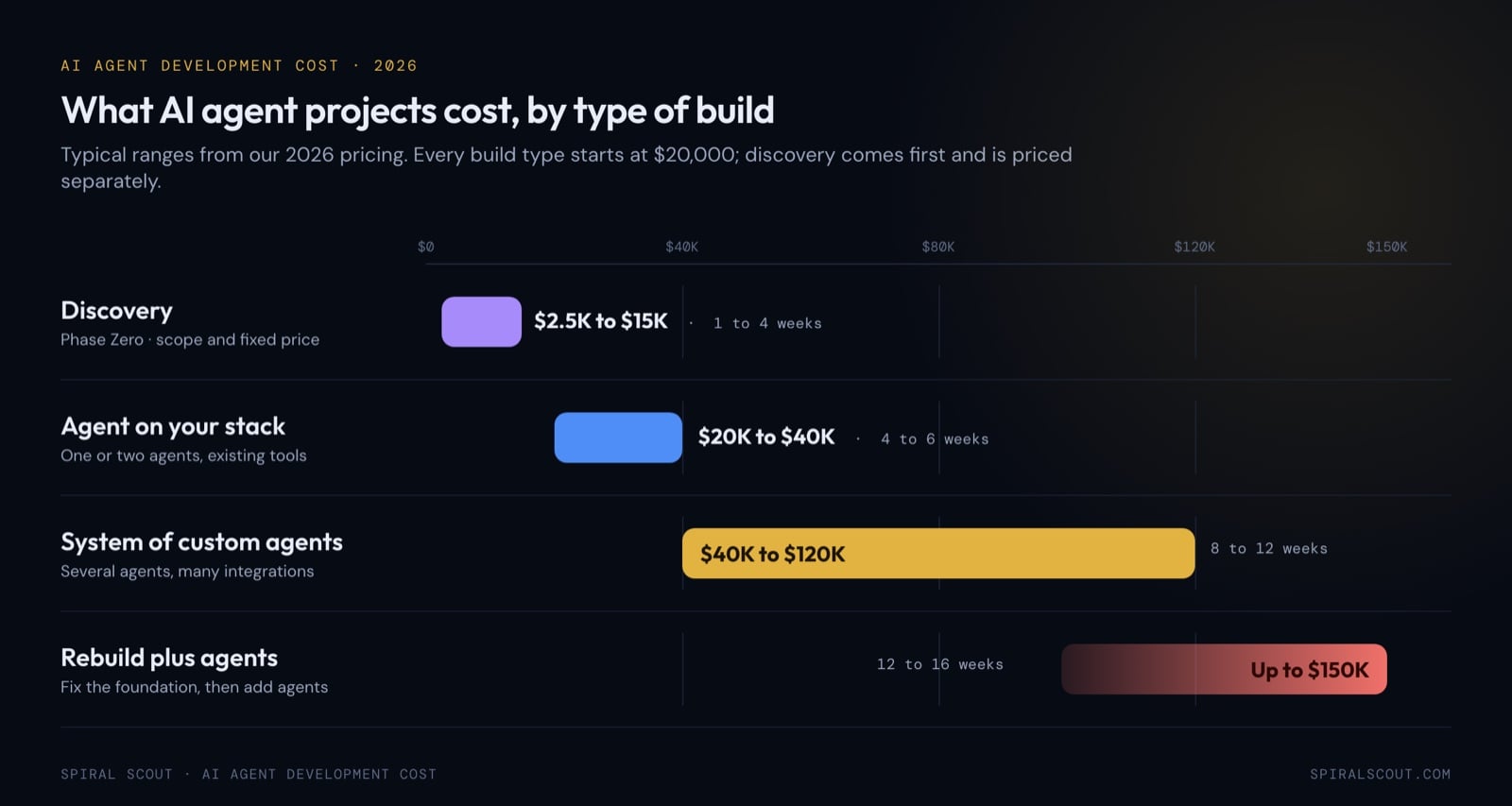
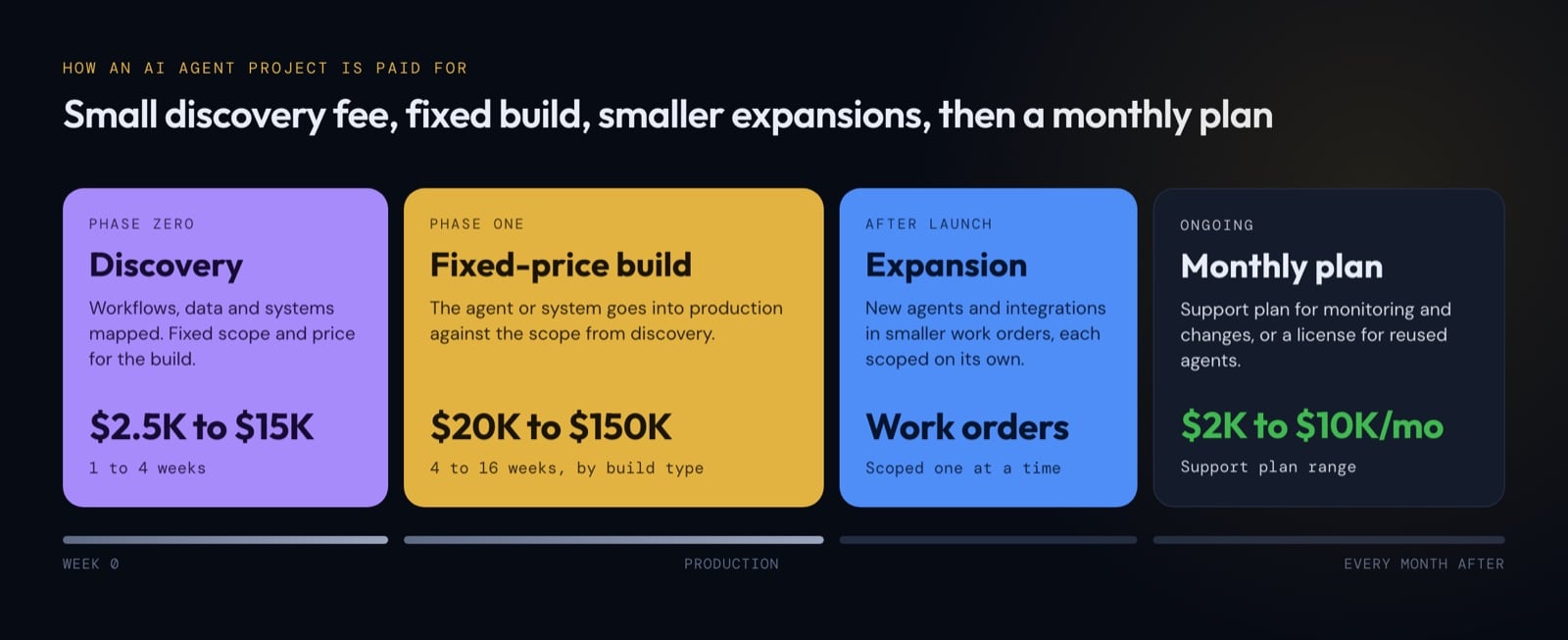
Short answer: Most production AI agent development projects we scope cost between $20,000 and $150,000 to build, plus a monthly cost to run. One focused agent working on systems you already have usually lands at $20,000 to $40,000 and takes 4 to 6 weeks. A system of several custom agents with multiple integrations runs $40,000 to $120,000 over 8 to 12 weeks. When the app or data underneath has to be rebuilt first, budgets climb toward $150,000. A short paid discovery phase of $2,500 to $15,000 comes before any of it.
“How much does an AI agent cost?” is usually the second question we get on a first call. The first one is whether AI can do the job at all. Both have honest answers, but the cost answer depends less on the AI than most buyers expect.
The model is the cheapest part of the build. What you pay for is the work around it: connecting the agent to your CRM or ERP, cleaning the data it reads, writing down the judgment your best people use, deciding what it may and may not do, and making it recover when something fails at 2 a.m. Those decide whether a project costs $25,000 or $125,000.
Below are the ranges we actually quote, the six drivers that move a project between them, what it costs to keep agents running after launch, and how to get a quote you can trust. These numbers come from Spiral Scout’s own pricing in 2026, not from a survey of other firms.
Key Takeaways
- Builds range from $20,000 for an agent on your existing stack to about $150,000 when the foundation has to be rebuilt first. A paid discovery phase of $2,500 to $15,000 comes before any of it.
- The model is the cheapest part. Integrations, data readiness, expert judgment, the risk of the agent’s actions, platform scope and reuse set the price.
- Budget for running costs from the first day: model usage, hosting, monitoring and the people who maintain the agent.
- An accurate quote needs your workflows, systems and data in front of the team, which is what discovery produces.
How much does it cost to build an AI agent?
We group AI agent work into three build types, plus the discovery phase that comes before them. Every type has a $20,000 floor, because anything smaller rarely survives contact with production systems.
| Project type | What it includes | Typical range | Timeline |
|---|---|---|---|
| Discovery (Phase Zero) | Workflow mapping, data and system review, architecture, a fixed scope and price for the build | $2,500 to $15,000 | 1 to 4 weeks |
| Agent on your existing stack | One or two agents, proven components, integrations into tools you already run, no app rebuild | $20,000 to $40,000 | 4 to 6 weeks |
| System of custom agents | Several custom agents, multiple integrations, moderate application logic, review gates and monitoring | $40,000 to $120,000 | 8 to 12 weeks |
| Rebuild plus agents | The foundation is broken (spreadsheets, a fragile legacy app, no clean data), so it gets rebuilt or migrated, then the agent layer goes on top | Up to $150,000, usually the top of the scale | 12 to 16 weeks |
The discovery fee is credited to the build if the build starts within 15 days. That means a good discovery phase costs you little when you go ahead and saves you a lot when you shouldn’t.
What drives AI agent development cost?
Two projects with the same one-line description (“an agent that drafts quotes”) can differ by four times in price. These six drivers explain almost all of the difference.
1. The number and quality of integrations
An agent that reads from one modern API is a small job. An agent that reads from a CRM, writes to an ERP, checks a pricing spreadsheet and posts to Slack is four integrations, each with its own authentication, rate limits and failure modes. Systems without an API, or with an API nobody has documented, cost the most. Integrations deserve the most scrutiny in any estimate.
2. How ready your data is
Agents amplify the data they read. If product names, part numbers or customer records are inconsistent, someone has to normalize them before the agent can be trusted. We have written before that your AI agent is only as good as your worst spreadsheet, and it shows up in budgets. For PIB Sales, a bearing distributor, the hard part of automating supplier imports was reconciling manufacturer files that described products in incompatible ways. Once mappings were saved and reused, an import that used to take months became one reviewed file the team prepares itself in minutes.
3. How much expert judgment the agent has to encode
Summarizing a document needs little domain knowledge. Pricing a configured product, qualifying a legal intake or deciding whether an order is safe to pay out needs the rules that live in your senior people’s heads. Capturing those rules takes interviews, examples and test cases, and it is the part that makes the agent worth having. Budget for subject-matter expert time as well as engineering time. Our guide to building a knowledge base for agents covers how we structure it.
4. How risky the agent’s actions are
A read-only agent that answers questions is cheaper to make safe than one that moves money, emails customers or edits records. Every consequential action needs a permission model, an audit trail, a review gate and a way to undo or compensate. We designed a marketing intelligence system to be read-only at the architecture level for exactly this reason, and every number it states is backed by a logged query. For an autonomous banking product at Staq, where agents handle real money movement in regulated markets, the engagement began as a 4-week architecture sprint on the orchestration model, agent lifecycle, isolation and audit strategy.
5. Platform scope around the agent
Agents rarely ship alone. If the project also needs a new user interface, user roles and permissions, billing, or a multi-tenant setup where each customer’s data is fully separated, those are full software features. In our estimates, multi-tenancy adds roughly half again to a build, a new interface about 30%, and authentication with permissions about 20%. Three or more of these usually turn a project into the rebuild category.
6. How much is reused versus built new
Reuse is the biggest lever on price. Connectors, review inboxes, document parsers and orchestration patterns that already run in production cost a fraction of new code. In one recent scoping, seven of the twelve components were proven infrastructure and only five were net-new. Ask any partner what they are reusing, and what you are paying full price for.
Why does a production AI agent cost more than the pilot?
A pilot proves the agent can do the task on a clean sample. Production proves it can do the task every day, on messy inputs, with people depending on it. The gap between the two is where most surprise costs come from, and it is the subject of our post on why working pilots fail in production.
Production needs five pieces of work that a pilot skips. Model calls time out, return malformed output or hit rate limits, so you need error handling and retries with a defined recovery path for each. You also need an evaluation set, a fixed set of real cases the agent must pass before every prompt, model or tool change, so improvements don’t quietly break something else.
Observability means traces of every model call and tool call, so you can answer “why did it do that?” in minutes. Review gates and permissions set clear rules for what runs on its own and what waits for a person, and our post on where review gates belong goes deeper. The fifth piece is deployment and handover: environments, access, documentation and a team on your side that can run it.
As a rule of thumb, if a quote for a production agent looks like the price of a demo, one of these is missing. Ask which.
What does an AI agent cost to run each month?
Build cost is a one-time number. Running cost is the one that grows with usage, so plan it before launch. It has four parts: model usage, hosting, monitoring and people.
For model usage, you pay the provider per token. The bill depends on volume, how much context each call carries, and which model each step uses. Routing simple steps to smaller models is the most effective control we know, and starting with the smallest model that can do the job also exposes defects early.
Hosting and infrastructure means the servers or cloud services for the runtime, database, queues and, for long-running work, a workflow engine. Monitoring and evaluation adds tracing, alerting and regular eval runs. The last part is people. Someone has to update prompts, add test cases, fix integrations when a vendor changes an API and answer “why did it do that?”
Clients usually cover the people part in one of two ways. A support plan, typically $2,000 to $10,000 a month depending on hours and response times, keeps a team on standby for fixes and improvements. An agent license, from about $800 to $2,000 a month for a single managed agent and $3,000 to $8,000 for a stack of three to five, covers hosting, monitoring and upkeep for agents we run for you. Either way, meter model usage per agent from the first day. If you can’t see which agent spent what, you can’t control it.
Is it cheaper to build an AI agent in-house or buy a product?
Buy when the job is the same at every company. Meeting notes, generic support chat and email triage are well served by off-the-shelf products that cost tens of dollars per seat. Building those would be a poor use of money.
Build, alone or with a partner, when the workflow is specific to how you win: your pricing rules, your intake criteria, your mix of systems. Products can’t encode that, and the judgment is the asset. Building in-house works when you already have engineers who have shipped LLM systems to production. In our experience, without that background the first build usually costs more in-house than with a partner because the team learns the production lessons on your budget.
There is a third question that matters more over three years than one: who owns the result. Managed agent platforms are quick to start, but you rent the rails. We compared the trade-offs in Claude Managed Agents vs Wippy. We build on infrastructure you control, and the code written for you is yours.
How to get an AI agent quote you can trust
The best quotes come from buyers who bring the right inputs, so have five things ready before you talk to any partner. Start with one workflow rather than a wish list: pick the process with the clearest pain and a measurable result, such as “quotes take two days and we lose deals to faster competitors.” Next, collect ten real examples, meaning actual inputs and the outputs your best person would produce. They become the first test cases.
Add a system list of every tool the workflow touches, with whether it has an API and who administers it. Set a success metric and a stop rule: the number that proves it worked, and what would make you stop early. Finally, name one owner who can answer questions within a day. Projects without one drift.
Then ask for a fixed-fee build with acceptance tests written into the scope. If a partner can only quote hourly with no defined finish line, the risk sits entirely with you.
Mistakes that blow AI agent development budgets
Starting with the hardest workflow is an easy way to overspend. Pick a workflow you can grade, win there, then expand. Building one agent to do everything causes a similar problem, because a single “universal” agent drops steps as the job grows. Smaller agents with narrow jobs are cheaper to test and fix.
Don’t use AI where rules would do. If the logic is deterministic, encode it as rules. In our CPQ work for Alaska Rubber Group, a rules engine and AI agents handle the configuration logic, Temporal workflows enforce each stage, and people step in only when needed.
Discovery is the wrong place to save a few thousand dollars, because the most expensive line in any budget is rebuilding on a foundation that was never checked. Run costs deserve the same attention. A build that fits the budget but costs more per month than the work it replaces is a loss.
Find out what your workflow would cost to automate
Our free AI Readiness Assessment takes under 10 minutes. Six questions give you a score, a plain-English read on your gaps, and the one process to fix first, which is the starting point for an accurate quote.